Atsuko Aokawa
APPEARANCE
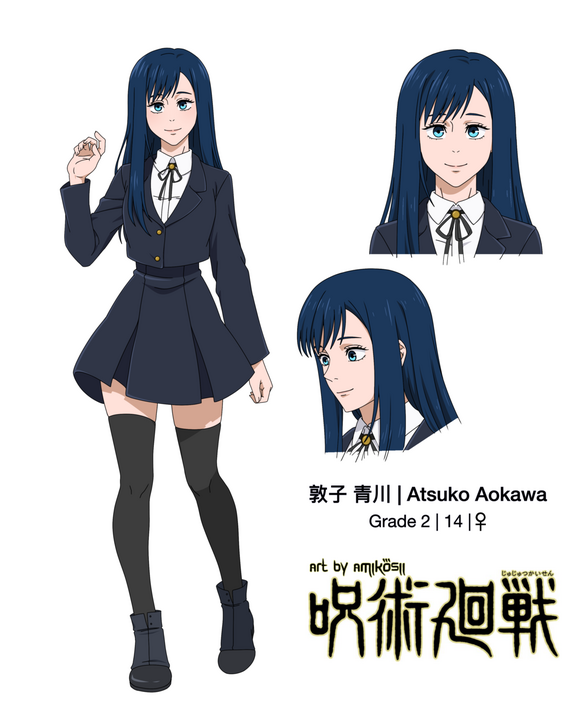
Atsuko has long dark-blue hair and light blue eyes that give her a soft, captivating appearance. Her facial features are gentle, and her expression is most often calm, with a faint smile. She has a soit body, narrow shoulders, and smooth, gentle curves to her legs, which make her movements look light and natural.
PERSONALITY AND BEHAVIORAL TRAIL
At first glance, Atsuko seems quiet, sweet, and obedient, but this impression is deceptive. In reality, she is lively, emotional, and sociable— she just doesn't open up to everyone. Atsuko laughs easily and often becomes a source of good mood within a group.— She can get upset and sulk if things don't go her way, but she can't stay angry for long
- She dislikes difficult and exhausting work, especially when it feels meaningless
— Sometimes she tries to postpone responsibility if there's an opportunity
— She prefers doing things "based on her mood" rather than out of a sense of dutyDespite this, in critical situations Atsuko is able to pull herself together. She's simply not someone who lives only by obligations—what matters to her is feeling joy, freedom, and warmth from those around her.
TABLE OF CONTENTS

Atsuko is a lively and curious teenager who enjoys discovering new things and being surprised by the world. She gets easily excited about interesting activities, can strike up a conversation effortlessly with people she likes, and sometimes shows a bit of sass or stubbornness. She enjoys small mischiefs and lighthearted rivalries with friends, but also values her personal space.
She tends to act on impulse, sometimes diving into things without much thought, and gets easily distracted if something feels boring. In interactions, she can be straightforward and sincere, not always worrying about what others might think. Still, Atsuko is capable of showing courage and determination when it’s important to protect herself or those close to her.
Her personality blends liveliness, emotionality, and a playful mischievousness, making her both charming and a little unpredictable.

Even in the Heian era, among high-ranking sorcerers there was a blacksmith whose skill surpassed human comprehension. He forged weapons from anything—stone, metal, curses, and even human bodies. The creation of each such blade demanded an immense toll from him, but in order to preserve his gift, the sorcerers imposed a special condition: the blacksmith was forbidden to step into the light or distribute his weapons without their approval. To the outside world, he was known only as a maker of beautiful ornaments; if the truth of who he really was were ever revealed, disaster would surely follow.
Weapons forged from the bodies of sorcerers were capable of altering their cursed techniques, making them especially dangerous to the world. He understood this and submitted to their will. Later, he married and had two sons. To ensure the continuation of his lineage and the preservation of the technique, one son would become the heir—if he inherited the cursed technique—while the other would continue the bloodline so that the craftsmen’s blood would not die out. Thus, the art was passed down from generation to generation, but along with it, a curse was inherited as well.
This curse was a vow bound to the family: every disciple who accepted the father’s knowledge was destined, at the end of their path, to forge a weapon from the body of their own teacher—the final and most perfect creation. This continued for centuries. Father and son, uncle and nephew—the blacksmiths passed their craft from hand to hand, carrying its burden.
But one day, children were born who dreamed of changing the fate of the clan. They wished not to hide their mastery, but to show it to the world, so that their family’s name would be known everywhere. This happened roughly seven hundred years ago. The fame of the clan spread quickly—sorcerers from all corners of the country came seeking their weapons. Even so, the family continued to conceal their whereabouts, fearing persecution and curses.
This went on for decades, until one day members of the clan began to disappear. Soon it became clear that someone had learned the secret of their blacksmithing art—the method of forging from the bodies of sorcerers. The elders then decided to reduce the clan. They ordered mothers and children to flee and never reveal their origins; the blacksmiths destroyed their homes along with their weapons, and the clan heads burned the archives, erasing all traces of their techniques’ existence.
Because of this, people believed the clan had been attacked and nearly wiped out. They hid from the world, preserving only a tiny branch of the family, and continued to forge in secrecy. Over time, others joined them, and thanks to this, the art did not fade away. The descendants of the first bloodline were sheltered, and the ancient fire continued to smolder.

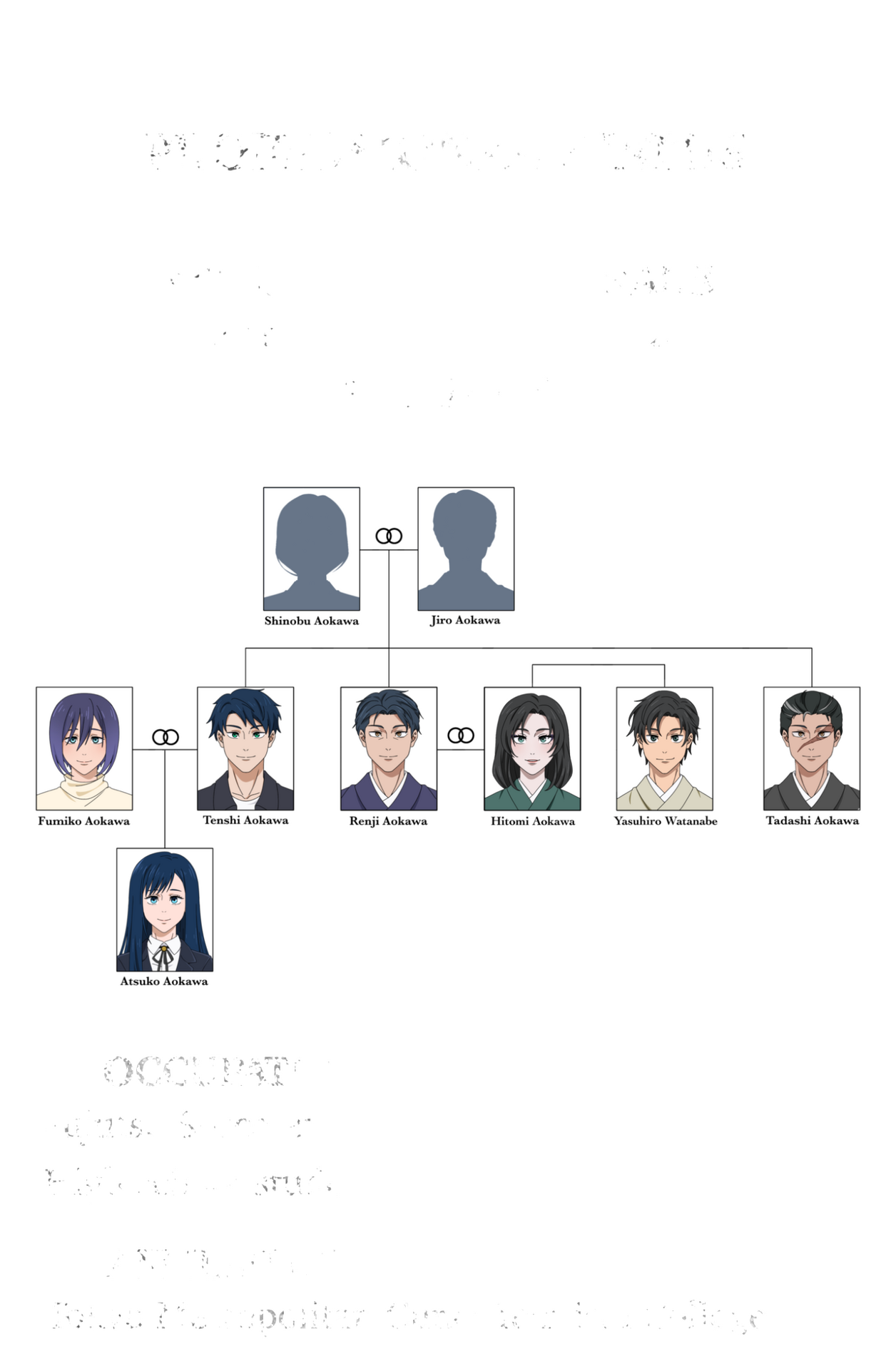
By the present day, only one family remains of the once-great clan: Jiro, his wife Shinobu, and their three sons—the eldest, Tadashi, gifted with exceptional talent; the middle son, Renji, quiet and level-headed; and the youngest, Tenshi, a dreamer with a kind heart.
Tadashi longed to restore the lost glory of their ancestors. He sought to revive forbidden techniques that had long been deemed dangerous and ignored his parents’ warnings. After prolonged arguments, he was cast out of the family. Tenshi, inspired by his brother’s freedom, soon left as well, leaving Renji behind on his own.
Later, Renji was married through an arrangement, but contrary to expectations, he truly fell in love with his wife—a woman whose eyes shone like the light of dawn. Their happiness was short-lived: they were unable to have children, and before long, she passed away.
Widowed, Renji buried himself in his work, as if trying to forge something eternal out of his pain. He worked day and night without rest, until one day he received a call from people he did not know. They informed him of the death of his younger brother, Tenshi. The news nearly broke him—he had always loved his brothers and kept hoping they would return. Yet soon, the reason fate had not allowed him to fall completely became clear: Tenshi had left behind a daughter.
Little Atsuko—a girl with a gentle gaze and a fearless soul. No one knew who her mother was, but Renji did not seek answers. He raised Atsuko as his own child, believing that in doing so he was fulfilling the wish of his late wife.
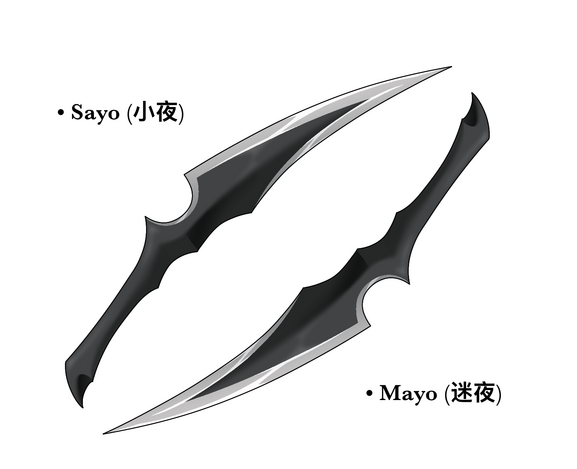
Years passed. Atsuko grew, and with her grew her interest in the world of sorcery. Renji tried to protect her, to keep her bound to an ordinary life. When Jiro and Shinobu passed away, they left behind one final request: to forge weapons from their bodies for their granddaughter—a symbol of protection and remembrance. Renji did not want to do it, but he kept his promise.
Thus, two blades were born—Sayo and Mayo. Even in death, the grandfather and grandmother continued to protect their granddaughter—the last heir of the ancient blacksmith clan.
THE STORY OF ATSUKO’S PARENTS
After leaving his parents’ home, Tanshi moved to a remote area. He rented a small one-room apartment and bought a truck with the money Renji had given him to help him get by. He found a good job, and one day he ended up staying late. That night, heavy rain was pouring down. With music playing and quietly singing along, he suddenly noticed a figure standing by the roadside. Startled by the silhouette, he braked sharply and stopped. Getting out, he asked if the person was alright—and then she lifted her head.
In that moment, something clicked in his mind. He was captivated by her. Quickly coming to his senses, he gave her his jacket and invited her into his truck, gently reassuring her that he would do nothing against her will. She got in, and he turned on the heater, slowly asking who she was and where she was headed. All he heard in response was that she had nowhere to go. He was surprised by such honesty, but also relieved that he had found her before someone dangerous could.
The drive to his place was long, and he began talking about himself, mentioning that he had run away from his parents’ home. She replied that she had just run away as well. They looked at each other—and suddenly started laughing. In that moment, he realized that he had probably fallen in love. When they reached the first store along the way, he offered his home as a shelter and said he would ask the landlady for an extra room. She agreed.
That was how they lived together, and later they married. Soon, they had a daughter, whom they named Atsuko. One day, when Tanshi was finally preparing to tell his family the truth, he was involved in a car accident. He and his wife died at the scene. Atsuko, fortunately, had been left with the landlady that evening—a woman with spiritual abilities who, though often grumbling at him, helped in any way she could.
When Tanshi had first begun his new life, she had insisted on having some address or contact information for at least one member of his family, in case something happened. Years later, that moment finally came. A man arrived, dressed in a traditional kimono, with dark circles beneath his eyes. Seeing how desperately he asked questions, she trusted him and handed Atsuko over. He thanked her and said that he would repay her properly one day.

This is how Atsuko began living with her uncle. She knew nothing about her mother—only a few photographs and the sparse stories her uncle had managed to learn. Atsuko was raised in a traditional way, but after the death of her grandparents, they moved to the city.
Renji did not want to leave her alone. He refused to hire a nanny, fearing that someone might take her away from him. He stopped trusting strangers and almost always took Atsuko with him whenever it didn’t interfere with her school schedule. Sometimes he left her with students from the technical college; other times, at the forge, with those he trusted most. This only fueled the fire in her eyes—she wanted to become a sorcerer.
Renji tried to distract her with various hobbies that changed like gloves, because his younger brother would have wanted her to live an ordinary life. But nothing helped. In the end, they reached an agreement: after finishing middle school, she would go to a technical college. She studied diligently and, from time to time, even attended the students’ training sessions to motivate herself further.

Atsuko’s early training follows much the same path as that of most sorcerers in her clan. The main focus is placed on a fundamental understanding of the world of sorcery: control of cursed energy, knowledge of the sorcerer hierarchy, the structure of the community, and the rules that must be followed to survive. This knowledge is considered essential, even for those who do not plan to become active combatants right away.
At the same time, Atsuko is introduced to the basics of blacksmithing. Her training is not meant to turn her into a full-fledged smith, but she learns the principles behind creating and maintaining cursed weapons, understands how to handle materials, and knows why mistakes in this craft can be deadly.
As she grows older, her training becomes more deliberate and structured, though without harsh pressure. She is allowed to develop at her own pace, balancing an ordinary school life with preparation as a sorcerer.
After graduating from middle school, Atsuko plans to enroll in the Tokyo Technical College to continue her studies within the official sorcerer system and finally determine her place in the world of sorcery

Atsuko’s technique allows her to transform cursed energy into a metallic substance and back again, enabling her to create blades, katanas, firearms, and much more. She can also turn her own body into metal, but remaining in this form quickly drains her strength.
Because of the nature of her technique, her cursed energy feels dense and cold, leaving a distinctive pressure in the air. Everything she creates looks not rough, but precise and carefully shaped, as if the form obeys her inner sense of rhythm. Even in the smallest details, it’s clear that metal is not merely a tool to her, but an extension of how she perceives the world.
While using her technique, Atsuko remains calm and focused, rarely giving in to impulses. From the outside, it may seem as though she acts on instinct, but behind it lies a subtle sense of control and caution. Her style does not seek showy brutality—it reflects a desire for balance between power and self-preservation.
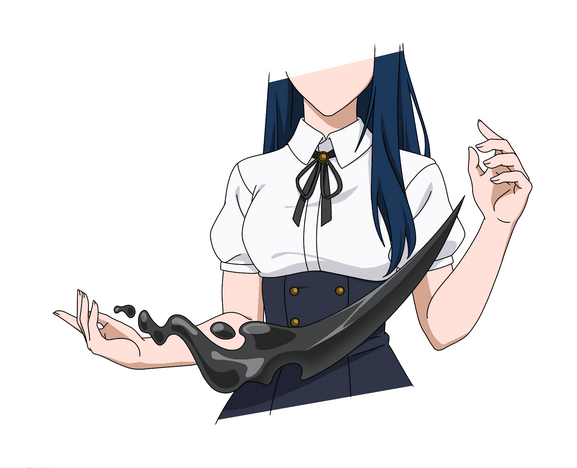
PROPERTIES OF TECHNIQUE
• Form Adaptation: The metal can take on any shape — from weapons to structures such as traps, spikes, or defensive walls.
• Activation Process: During activation, Atsuko channels cursed energy into her bone structure, replacing organic tissue with a cursed alloy resistant to impact and tearing.
• Synergy with Others: She can create weapons that enhance other sorcerers, such as temporary cursed tools for allies.
• Combat Intuition: The metal Atsuko creates can “respond” to her thoughts and reflexes faster than ordinary weapons.
• Metal Butterfly Swarm: Atsuko releases a swarm of metallic butterflies that scatter across the battlefield. They distort the perception of cursed energy, distracting opponents and disrupting their concentration. During this moment, Atsuko can reposition, hide, or prepare her next move.
RESTRICTIONS
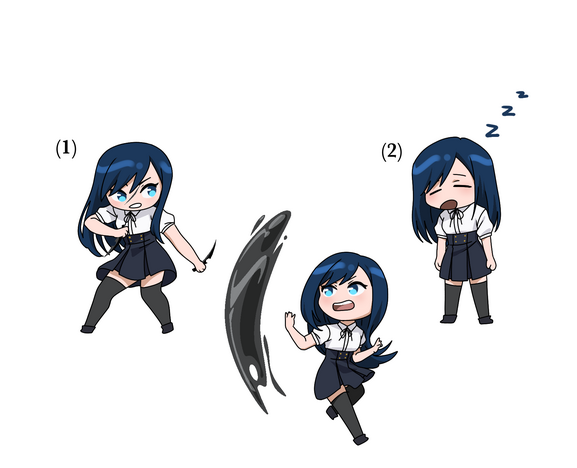
• Maintaining the metallic form rapidly drains cursed energy (2).
• Creating multiple objects at once reduces concentration.
• Emotional instability distorts the shape of the metal.
• Under heavy impact, the metal can crack, increasing the risk of breakage, though it can later be reassembled from the fragments (1).

Atsuko’s main family home, where she grew up, is located on an island. For many years, members of the clan hid there, but later it became known in the world of sorcerers as a place where cursed weapons are forged. Their main clients are the two jujutsu technical schools, for which they produce weapons on a large scale. Custom orders are also possible, but they are significantly more expensive.
At present, the only member of the main clan actively working there is Renji. The rest are people connected to the clan. The second most important figure is Yasuhiro, the younger brother of Renji’s late wife. He does not possess the clan’s cursed technique, but even without it, his talent is extremely valuable. Secretly, he is being considered as the future head—not of the clan itself, but as the master blacksmith.
Yasuhiro became a good older-brother figure for Atsuko. They didn’t see each other very often, but in childhood they frequently fought with one another (he was constantly punished for it, even when he wasn’t the one who started—haha). Now he has graduated from high school and is studying the craft of blacksmithing under Renji. He stays on the island most of the time and leaves mainly to train at other forges across Japan.
Renji, in turn, has a small forge at one of the technical schools, where he goes for quick weapon repairs. In worse cases, the weapons have to be sent to the main forge. He stays there for an entire week once every one to two months, and does the same at the other technical school.
As for Atsuko—at the time of the anime (2018), she is in her final year of middle school. She doesn’t visit the technical schools as often as she used to, but still comes by from time to time. She visits them wearing her school uniform. Although she does have her own sorcerer uniform, Renji has forbidden her from wearing it until she graduates. Instead, she has an alternative outfit consisting of a shirt, a plaid skirt, and a short haori. It’s essentially a school uniform with a haori, but with the technical school’s button, it functions as her uniform.
.